
An Interview with Jonathan Rogers
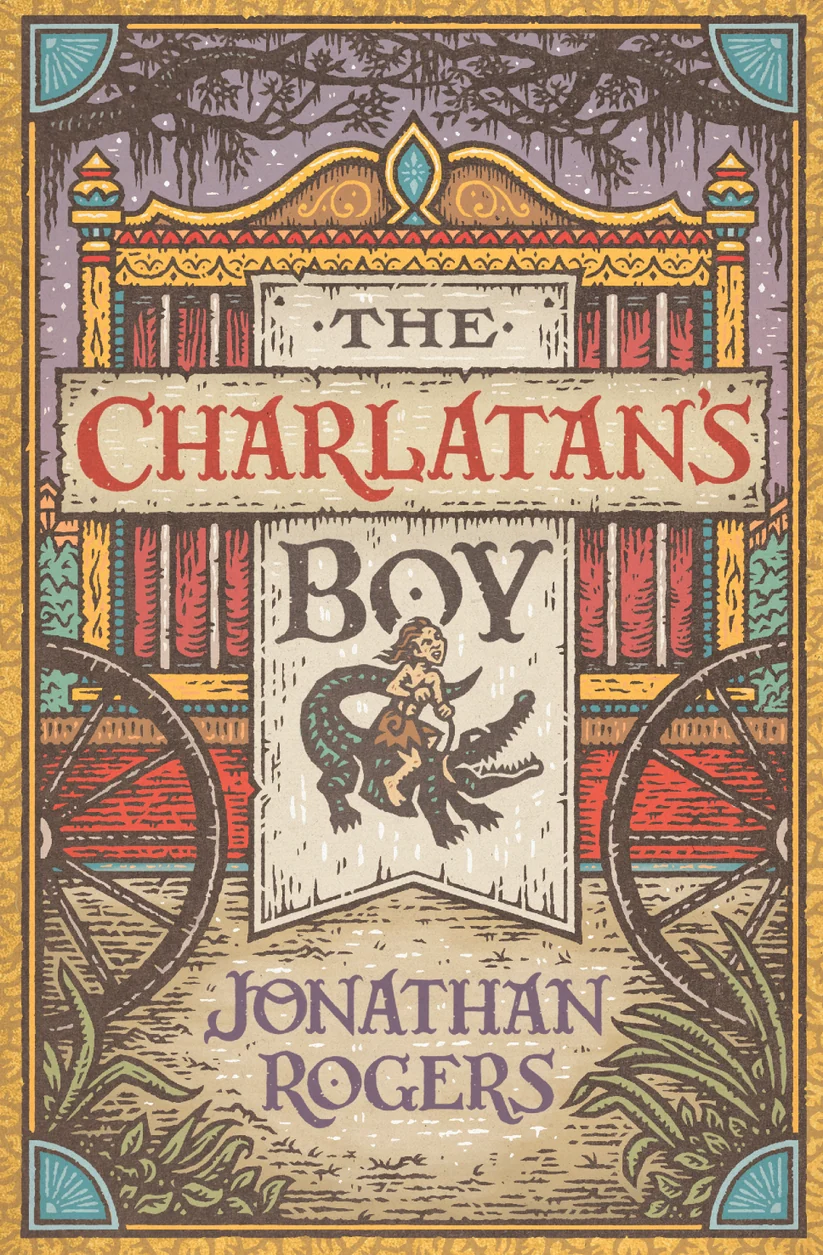
Editor’s note: If you’re looking for your next great family read-aloud, look no further than The Charlatan’s Boy from Jonathan Rogers. You may be familiar with Jonathan’s other books, The Wilderking Trilogy; The Charlatan’s Boy exists in the same universe, but is a stand-alone story. I teared up when I read this one to my kids many years ago. The book is being rereleased by Rabbit Room Press to celebrate the title’s fifteenth anniversary since publication. You’ll find new illustrations from Joe Hox and a beautiful new cover from Stephen Crotts. It was a delight to connect with Jonathan to find out more about this title!
KK: For readers who may not know your story, can you talk about your path from a PhD in seventeenth-century English poetry to the wild swamps of Georgia present in The Charlatan’s Boy and The Wilderking Trilogy?
JR: It’s true that I have a PhD in seventeenth-century poetry, which I still love. But when it came time to write on my own account rather than writing about what other people had written, I had to leave seventeenth-century England and come back to the swampy South (or, more properly speaking, an imaginary place that looks a whole lot like the swampy South). Being a seventeenth-century English poet was never in the cards for me.
As much as I love John Milton, John Donne, and the other poets of the seventeenth century, it was Flannery O’Connor who helped me understand what my calling as a fiction writer might look like. That sounds high-falutin. I’m sorry. All I really mean is that after a decade or more of an academic career in which writing seemed like a kind of ventriloquism or expatriation, I came back to Flannery O’Connor and saw somebody who was writing in her native tongue. And since Flannery O’Connor and I both grew up in Middle Georgia, her native tongue was the same as mine. So even though I don’t claim to be able to do what Flannery O’Connor could do, she at least gave me some parameters of how to do what I could do. The language, the people, the land forms, the animals, the plants, the social relations, the jokes and stories of my native country (and anybody else’s native country) are the raw material of fiction, high and low.


I always tell the writers at The Habit that the writer’s job is to give the reader something she can’t get for herself. A closely related idea is that the privilege of a writer is to invite a reader to love what he (the writer) loves. Ideally, the writer is inviting the reader to love what it has never occurred to the reader to love before. When it comes to swamps, I’ve got a lot of love to give.
KK: Just playing favorites here, because I love her: can you say anything about the character of Short Fronie? Do you remember how she came to life in your imagination?
JR: I’m crazy about Short Fronie. She’s a woman keeping a tavern frequented by these rough customers—boatmen and stevedores and cattle drovers and “show people” who are mostly charalatans and ne’er-do-wells—so she has to be tough, but she’s not cynical. A lovingkindness and a strong sense of justice has survived in Short Fronie. In that way she’s a role model for Grady, who is trying really hard to be good and honest and loving in circumstances that don’t seem to reward goodness and honesty and where love feels like a short road to heartache. He stays open even though he has every reason to shut down. Fronie, short of stature but big of heart, shows that it’s possible to keep up that openness indefinitely.
But you asked how Short Fronie came to life in my imagination. I was involved in a car accident a few years back. I was ready to be magnanimous to the other driver, who was clearly at fault. The driver, who looked like he was probably headed to work at a downtown law firm, jumped out and started yelling and blaming, which made me feel less magnanimous, and he got more agitated, which made me agitated. A policeman showed up very quickly, but even though he was trained to deescalate, he actually made things worse. Soon the tow truck arrived, and the driver got out and approached the verbal melee. He was six and a half feet tall, big around the middle, missing at least one tooth. But he had the kindest, gentlest spirit, and he immediately brought a sense of calm to the situation. He called my lawyer-antagonist “Honey.”
The policeman, the official authority figure in the situation, was unable to bring peace. But the tow-truck driver exuded a moral authority and a non-anxious presence that made it seem silly to argue over a matter so trivial as a wreck in which two cars got totaled but nobody got hurt.
Anyway, I filed away that tow-truck driver, who looked to have so few advantages but so much kindness, competence, and good sense. Somehow I got from him to Short Fronie. I haven’t thought about him in a long time. Thanks for giving me a reason to remember him.
KK: This book talks about the longing for home; being “lonesome for” a person; and the quest to understand where we come from and where we belong. Did any of those themes solidify for you as you wrote the story? Did anything surprise you?
JR: That’s an interesting question. I have never felt like I had any business feeling lonesome. I have always had plenty of people around, and I have always known that a respectable portion of those people love me and I love them. Nevertheless, I sometimes feel lonesome and disconnected. I have always liked sad country songs. I used to say it was because, having no real sadness in my life, those songs provided an opportunity to experience a sadness that I hadn’t earned. Sort of a self-indulgent sadness tourism. Now I think it is more accurate to say that sad country songs give me something to hang my free-floating sadness and lonesomeness on. It’s true that I have a happy life; it’s true that a lot of other people have suffered loss and hurt and hardship in ways that I never have. But I still experience sadness and loneliness as the result of the fact that I am a human being living in a world that can’t fulfill all the longings of the human heart. So Grady’s lonesomeness isn’t entirely imaginary. It’s my own free-floating lonesomeness, given a local habitation and a name.

When I narrated the audiobook a couple of months ago, a number of things in the book hit me in new ways—things that were there all along, but now seem closer to the book’s heart than I realized sixteen years ago. In Grady’s conversation with Short Fronie, he takes it for granted that he’s lonesome and unloved because he’s so ugly (he is, after all, so ugly that he can make a living on his ugliness). Fronie says, “Just because you’re ugly that don’t mean you ain’t lovable,” or words to that effect. I love the wisdom of that remark. She doesn’t tell him he’s not ugly. She tells him he can be loved. That idea pays off later when Grady sees Barbary crying for sadness and loneliness. Barbary is the most beautiful person he knows, so he’s astonished that she can be sad and lonesome. Grady has sense enough to see that being loved is more important than being attractive. And not just being loved, but having the opportunity to love others. Barbary asks Grady if he loves Floyd, his guardian, employer and a thoroughgoing scoundrel. Grady says everybody’s got to love somebody, and Floyd’s the only person he’s got. Barbary contradicts him: there are plenty of people who don’t feel the need to love anybody but themselves. And Grady says “Well I’ve got to love somebody.” I think that little moment of self-awareness explains so much about Grady, including the choice he makes in Short Fronie’s tavern, which I won’t spoil here.
Decent novels are wiser than their authors. I think those scenes with Fronie and Barbary are quite a bit wiser than I am.
KK: How did writing The Charlatan’s Boy change your perspective and direction as a writer and a teacher?
JR: What really changed my perspective and direction was what happened after the book came out. I had completely unrealistic expectations regarding its commercial prospects. I was so proud of The Charlatan’s Boy: I felt like it was by far the best thing I had written, and for some reason I thought that meant is would be my “breakout” book. Don’t ask me why I thought that my love for my own book should translate into book sales. It came out, and it did not sell. Of my four novels it was the fourth-best-selling, and by a good margin. And the other three books weren’t even big sellers! I was so heartbroken by that commercial failure—or, perhaps I should say, by the book’s failure to meet my absurd sales expectations—that I was forced to do some soul-searching. Why did I so badly need the approval of people I didn’t know? Why did I feel the need to be loved by people I couldn’t love back? I had real people in my life who loved me, and my book was loved by smart friends whose opinion I valued. I was proud of the book and in moments of sanity I was grateful just to have had the opportunity to write it. Through the process I realized that I was going to have to have a different relationship to the work. I couldn’t continue to view book sales as a measure of my worth or the worth of the work. I knew that in my head, of course, but the heartbreak I felt after The Charlatan’s Boy released demonstrated that the knowledge hadn’t made it down to my heart. To make a long story short, I went back to teaching as a way to loosen my hold on some idols and also to decouple the family finances from the vagaries of the publishing industry. One thing led to another, and The Habit grew out of my understanding that my calling was to shepherd good stories into the world, whether I’m writing those stories myself or helping other writers get their stories written. The failure of The Charlatan’s Boy the first time around did good work in my life. If it had met my imaginary expectations, I would probably have been insufferable, and I almost certainly would have missed out on the blessings that have come my way in The Habit.
KK: Your books are a testament to your sense of humor. What makes you laugh these days?
JR: P.G. Wodehouse. I listen to Jeeves and Wooster audiobooks when I’m watering flowers or pulling weeds or washing dishes or walking the dog. You hear about people having misspent youths. I hope I’m not misspending my middle age with too much Jeeves and Wooster.

When she’s not behind her laptop, Kelly enjoys live music, baseball, reading great books, and traveling with her husband, David. Kelly hails from beautiful snowy New England, but after two decades in North Carolina, she feels right at home.
She invites you to subscribe to her newsletter, On the Common, or to follow her on Instagram.
- Story Warren Weekend, Vol. 14, Issue 41 - November 7, 2026
- Story Warren Weekend, Vol. 14, Issue 40 - October 31, 2026
- The Great Pumpkin and the True Meaning of Christmas - October 28, 2026

Favorite Posts
Our Heart for Middle Grade Readers
Beauty Will Win
Introducing the Mended Wood Literary Society
In Praise of Generalists
Making the World More Beautiful (with Miss Rumphius)
Anticipating The Right-Side-Up World Through Imagination
Imaginations Should Be Exercised
Why Story Warren?