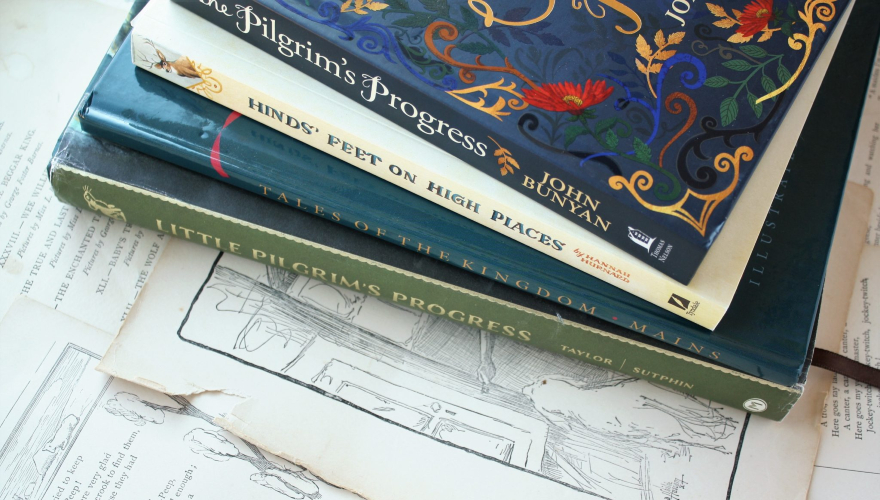
When it comes to allegories, people have Opinions. Some readers find them unbearably cheesy, which is, I guess, understandable: few things grate on the nerves like a story that’s too handholdy—the kind that tells us what we’re supposed to think about every element of the story. And allegories can certainly come across as handholdy. There’s no dodging it: every allegory mentioned in this post features characters whose names explicitly tell you what they’re meant to represent within the story.
But you know what? I love allegories. I love the way they take an abstract truth and, by portraying it as a character, bring it to life. Allegories give those truths structure and presence—they give them a body. And I love what allegories do in our hearts as our family reads them: they give us illustrations we can return to when faced with a difficult moment. “Remember when Little Pilgrim strayed from the path?” we might say. “This situation is kind of like that because . . .”
When reading Little Pilgrim’s Progress we’re reminded that our life is not a linear line but a journey, filled with moments of peril and conviction as well as rest and peace. When reading Hinds’ Feet on High Places, we remember that our Shepherd is just a call away and that he’ll come bounding down the mountainside to our help when we call. Of course the best stories can also have this effect, allegorical or not, but allegories excel at it: they give us something concrete to picture in those moments when our vision is clouded by grief or discouragement or doubt.

So, here are a few of our family’s favorites. There’s a little something on this list for all age levels, so I’ve organized it from the ones written for the littlest readers to the ones written for the biggest.
Little Pilgrim’s Progress, by Helen L. Taylor (& Joe Sutphin)

This adaptation takes the big truths of John Bunyan’s classic Pilgrim’s Progress and translates them into characters and images that are accessible for young readers. Joe Sutphin’s illustrations in this edition open them up further. (Read the full review.)
Tales of the Kingdom, by David & Karen Mains

Tales of the Kingdom was written in the eighties (you can see it in the artwork), which makes this one feel the most like modern life. These books are full of delightful stories and a prince we all long to know better. (Read the full review.)
Hinds’ Feet on High Places, by Hannah Hurnard

Hannah Hurnard’s tale of Much-Afraid and her journey to the High Places is one worth meditating upon and savoring. My older daughters love this one; I keep a copy by my bed so I can read a little each day. (Read the full review.)
The Pilgrim’s Progress, by John Bunyan
The grand-daddy of allegories, Pilgrim’s Progress follows Christian as he journeys from the City of Destruction to the City of Light—and is waylaid, challenged, or fortified by those he meets along the way. This edition features updated language and some annotation that makes John Bunyan’s old-school language open up for modern readers. Another point in its favor? It’s so pretty!

- The Mousehole Cat - April 3, 2024
- Review: Jesus and the Gift of Friendship - March 27, 2024
- Review: James D. Witmer’s A Nose For Trouble - December 4, 2023
Fantastic, thank you Thea!